

AchieveDx pharmacogenomic testing
One cheek swab shows how a patient's genetics affect their response to medications across cardiology, mental health, pain management and more.
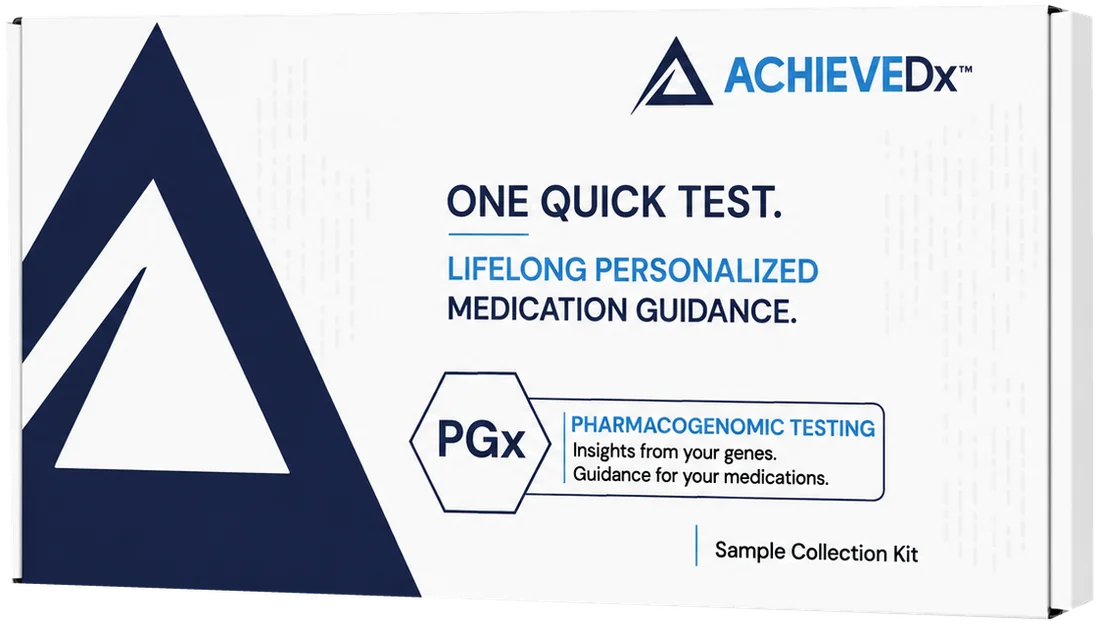
One box, one swab, one lifetime of guidance
- Swab and step-by-step instructions inside the box
- Label with patient name, date of birth and collection date
- Ship the day of collection, or refrigerate until it ships
- Seal the specimen in the same box and ship it to the lab
The right medication, at the right dose, at the right time
A patient's genetic profile doesn't change. Their medication list does. One test gives prescribers drug-gene insight they can use for future prescriptions.
- 01
Less trial and error
Can help reduce failed medications and the risk of adverse drug reactions.
- 02
Safer prescribing
Flags drug-gene interactions and genetic risk for adverse reactions.
- 03
Better-tolerated choices
Helps prescribers choose therapies patients are more likely to tolerate.
- 04
Readable reports
Clear, color-coded results plus a pharmacist-written summary.
Where PGx changes prescribing
Cardiology
Supports drug selection for antiplatelets and statins.
Mental health
Supports antidepressant and antipsychotic selection.
Pain management
Helps identify patients unlikely to benefit from codeine or tramadol.
Primary & complex care
Supports prescribing decisions in polypharmacy.
Every medication on the report
Browse the full list, filter by therapeutic area or search by generic or brand name. Select a medication to see how a result can guide prescribing.
Medication list from the AchieveDx PGx report. Whether a result changes therapy depends on the patient's genotype and full clinical picture. For information only, not medical advice.
Key moments in the patient's care
PGx testing fits at four points in a patient's treatment. Test once, and the results can inform future prescribing.
- Moment 1
Therapy initiation
Avoid trial and error from the start.
- Moment 2
During treatment
Address side effects, poor response or adherence problems.
- Moment 3
Dose optimization
Guide dosing, especially for narrow therapeutic index drugs.
- Moment 4
Therapy failure
Find genetic factors behind a poor response.
Establishing medical necessity
For Medicare (MolDX), document these in the order. A history of side effects, therapeutic failure or dose instability supports the record but isn't enough on its own. Testing isn't covered based on a diagnosis alone.
- The specific drug being considered or currently used
- That it has an actionable gene-drug interaction (CPIC level A/B or FDA labeling)
- How the result will guide dosing or drug selection
- That non-genetic factors were also considered
Built on established guidance
Recommendations on the AchieveDx report reference these guideline and labeling sources.
Evidence-based prescribing recommendations for actionable drug-gene pairs.14
Pharmacogenomic information in the labeling of hundreds of medications.15
Guidelines used to guide prescribing in the PREPARE trial.1,19
Recommends CYP2C19 testing to guide clopidogrel after ischaemic stroke or TIA.20
Organizations are listed as reference sources and do not endorse AchieveDx.
Where the data is strongest
CPIC has published 29 guidelines covering more than 160 drugs and 35 genes (as of October 2025), and the FDA maintains a table of pharmacogenetic associations for drugs with labeling or evidence of gene-drug effects.14,16
Clopidogrel must be activated by CYP2C19, so carriers may get less antiplatelet effect and have a higher risk of cardiovascular events. A 2024 American Heart Association scientific statement concluded that the evidence to date supports CYP2C19 testing before oral P2Y12 inhibitors in ACS and PCI.
Lee CR, et al. Clin Pharmacol Ther, 2022 (CPIC); Pereira NL, et al. Circulation, 2024 (AHA)9
Ultrarapid metabolizers convert codeine to morphine too quickly, which can cause life-threatening breathing problems. Poor metabolizers get little pain relief.
Codeine FDA prescribing information17
Examples of FDA drug labeling
| Drug | Gene / phenotype | FDA label guidance |
|---|---|---|
| Clopidogrel | CYP2C19 poor | Boxed warning Consider another P2Y12 inhibitor in CYP2C19 poor metabolizers. |
| Codeine | CYP2D6 ultrarapid | Boxed warning Life-threatening respiratory depression and death in children who received codeine, many of whom were ultrarapid metabolizers. |
| Citalopram | CYP2C19 poor | Dose limit Maximum dose of 20 mg/day in CYP2C19 poor metabolizers. |
Sources: FDA prescribing information for each drug; CPIC; FDA Table of Pharmacogenetic Associations.14,16,17
Figures come from published studies of PGx-guided care in other programs and populations. They are not results of AchieveDx's test. See references.